
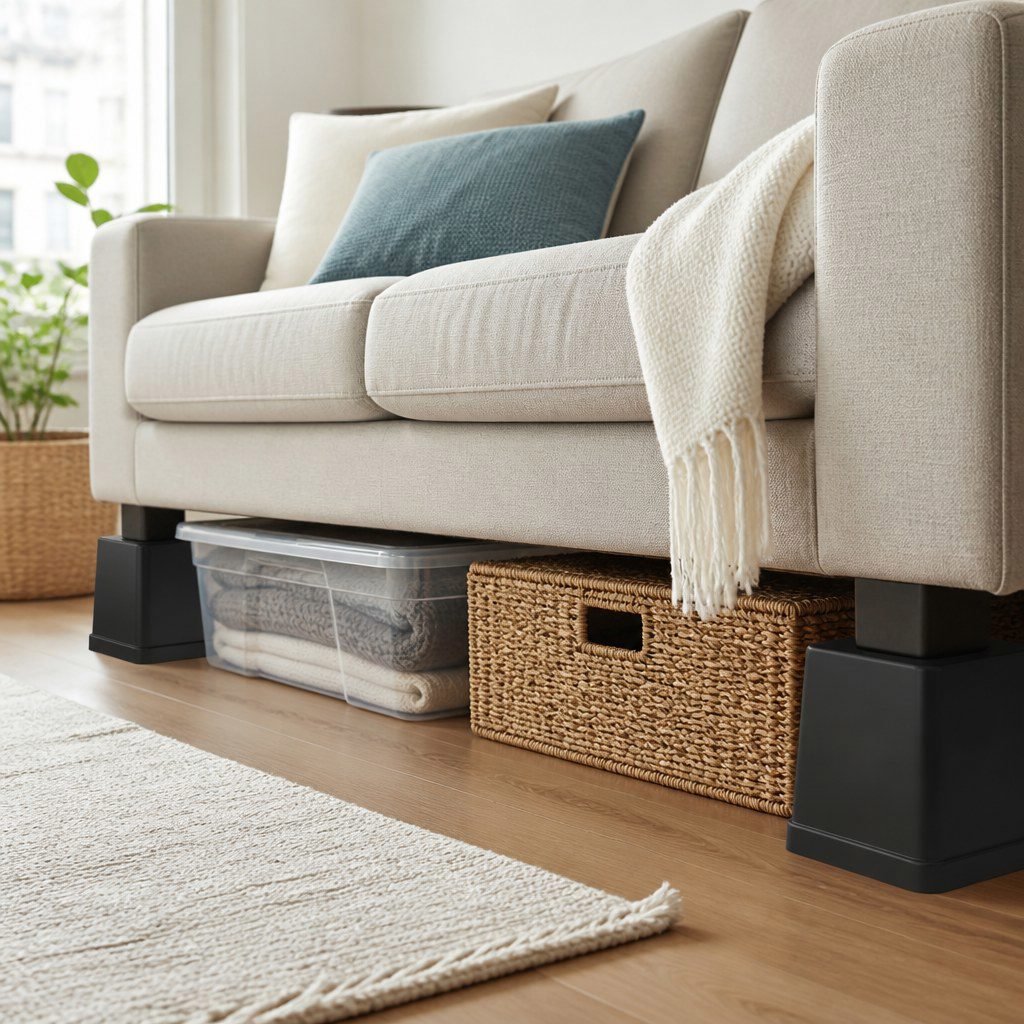
No-Drill Furniture Risers and Storage for Small Apartments
No-drill furniture risers create usable space beneath beds, sofas, and tables without altering the furniture or apartment. Choose a set that supports the manufacturer-listed weight, matches every leg or caster, and raises the item only as high as needed. A 4-leg bed requires 4 stable contact points.
By Olami Y.
Last updated November 03, 2026
What works without drilling?
Freestanding risers, low-profile bins, zippered bags, rolling drawers, and tension-based organizers can add storage without screw holes. The safest combination depends on your furniture’s feet, total loaded weight, floor surface, and available clearance.
Start with space you already have. Under-bed storage usually offers the largest continuous area, while the space beneath a sofa suits shallow items that you use less often. A console or desk can take small stackable drawers if they do not restrict your legs.
Under-bed bins
Choose rigid bins for frequent access. Choose zippered fabric bags for bedding or seasonal clothes that need less structure.
Furniture risers
Use purpose-made risers with recessed tops or secure caster cups. Avoid improvised blocks, books, or containers that can split or slide.
If floor space is already tight, pair this approach with Domoviq’s damage-free wall storage ideas or reversible DIY picks for renters. Keep heavy belongings low rather than transferring all storage overhead.
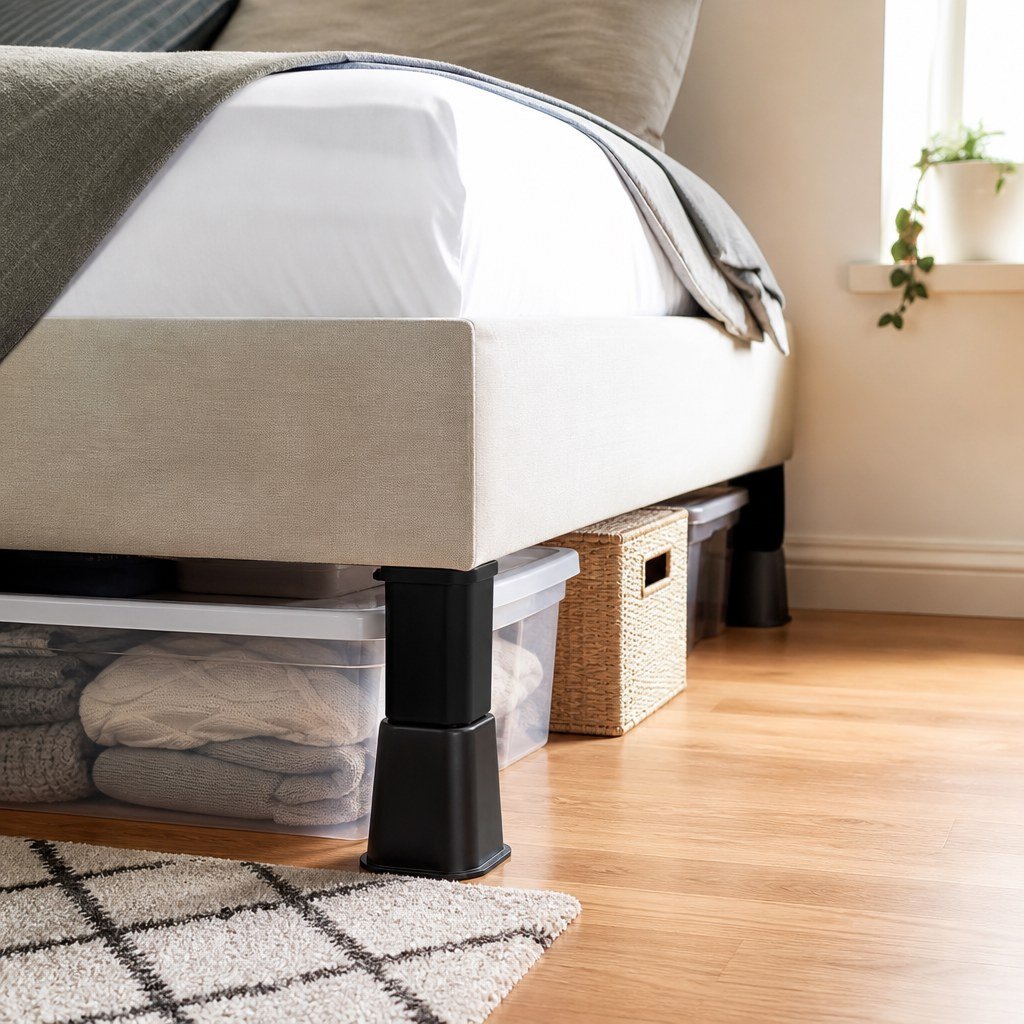
How do you choose safe furniture risers?
Choose risers by compatibility and rated capacity, not by height alone. Check the current manufacturer listing and instructions because dimensions and load limits differ between models.
- Measure the width and shape of each furniture foot, including rubber pads or glides.
- Calculate the loaded weight by including the furniture, mattress, occupants, and stored belongings.
- Confirm whether the stated capacity applies to one riser or the complete set.
- Measure the desired clearance from the floor to the lowest rail, support bar, or fabric panel.
- Select a top recess that fully contains each foot or caster without balancing it on an edge.
Wide risers spread the load across more flooring and tend to feel less precarious than narrow, tall designs. On hard floors, look for a nonslip base that will not stain the finish. On carpet, check that the base sits flat instead of rocking on thick pile.
Test the final height before buying bins. A riser advertised by its own height may provide less additional clearance because the furniture foot sits inside a recessed cup.
Which storage format fits your apartment?
Match the container to access frequency and clearance. A shallow bin that slides out cleanly is more useful than a larger box that catches on the frame every time.
Leave a little clearance above the container so it does not scrape upholstery or bed slats. Label the outward-facing end. If you must move another box to reach it, the layout will become frustrating fast.
Use the Domoviq tools hub to plan other renter-safe upgrades around your available space.
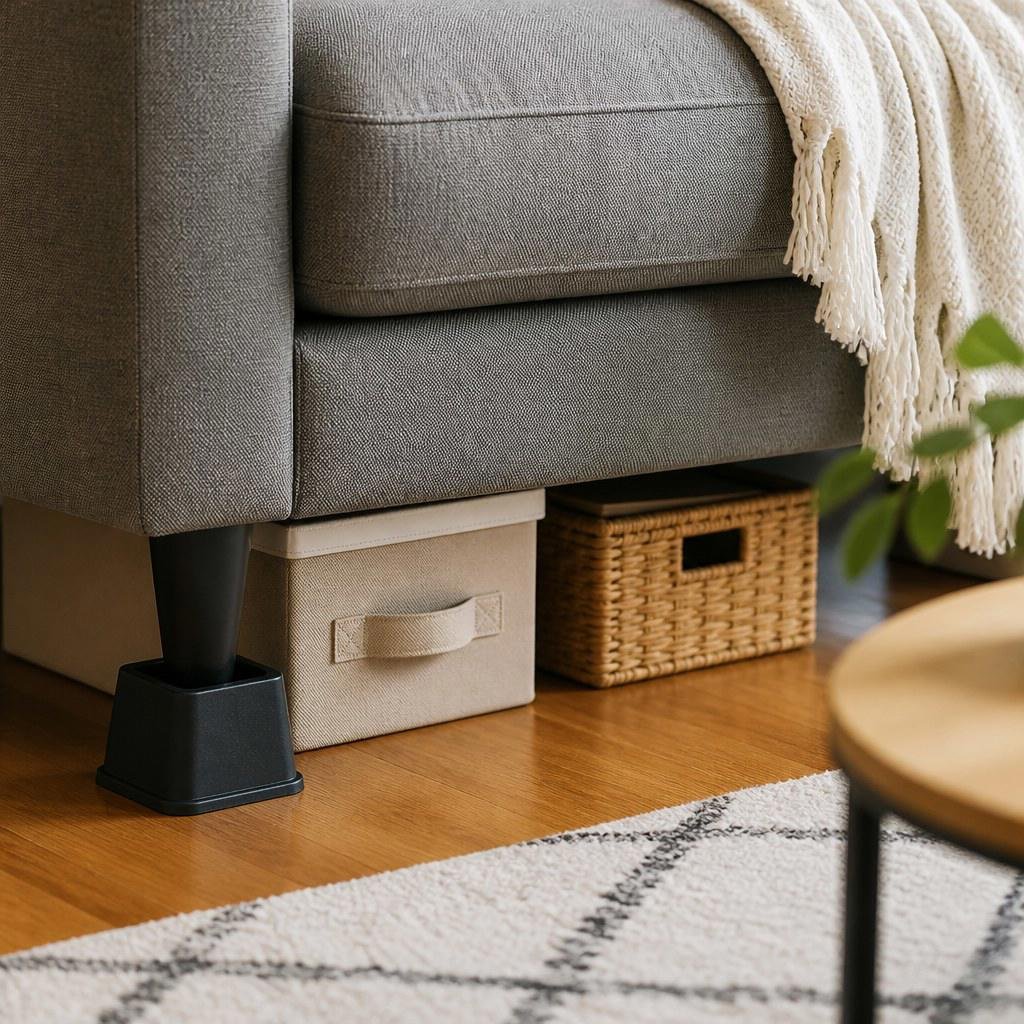
How should you install and test risers?
Install risers on an empty piece of furniture, then check every contact point before restoring the load. Ask another adult to help lift bulky furniture rather than tilting it with your hands near the legs.
- Remove drawers, bedding, electronics, and loose objects to reduce the lifting weight.
- Clean the floor and inspect every leg, caster, joint, and riser for cracks or looseness.
- Lift one end with help and place matching risers beneath every support point at that end.
- Repeat at the opposite end without dragging the first risers out of position.
- Lower the furniture slowly and confirm that each foot sits centered in its recess.
- Press gently from several sides, then sit or lie down carefully while your helper watches for movement.
- Recheck the setup after the first day and whenever you move the furniture.
Stop if a riser rocks, bends, slides, or makes cracking sounds. The cheapest fix is usually to reseat the foot and clear debris from beneath the base. If that fails, remove the risers and choose a wider compatible design.
Risers do not prevent furniture tip-over. The U.S. Consumer Product Safety Commission advises anchoring furniture to the wall to reduce tip-over risk. If your lease restricts holes, ask the landlord for written permission or help; adhesive straps are not an automatic substitute for manufacturer-approved anchoring. Domoviq’s renter-safe furniture anchoring guidance can help frame that conversation.
What mistakes waste the most space?
The common failures come from measuring the container instead of its path, raising furniture too far, or treating hidden storage as unlimited capacity.
- Measure baseboards, center supports, low rails, and rug edges along the complete pull-out route.
- Keep rarely used belongings toward the center and daily items near an open side.
- Avoid stuffing loose objects underneath, where they collect dust and become hard to inventory.
- Do not block floor vents, electrical cords, power strips, heaters, or a robot vacuum’s route.
- Check flooring periodically for dents, color transfer, trapped moisture, or scratches.
Choose one furniture piece now, empty the area beneath it, and record its foot dimensions, loaded weight, and true floor-to-frame clearance before you shop.


